
Vincent JOSSE
Vincent is an SEO Expert who graduated from Polytechnique where he studied graph theory and machine learning applied to search engines.
LinkedIn ProfileDoes publishing with BlogSEO actually move a website in Google? We wanted an answer built on numbers rather than testimonials, so we went to the data Google itself provides: Search Console.
We studied a dataset of 459 BlogSEO websites. To compare like with like, the averages use fixed panels with 10 full months of Search Console data, from 6 months before the first BlogSEO article to 3 months after: 459 websites for ranking keywords and 419 websites for clicks and impressions.
On those panels, 3 months after joining, websites ranked for 2.12× as many keywords as before on average, received 2.01× as many clicks from Google on average, and earned 2.68× as many impressions on average. Below you will find the month-by-month curves and the methodology and limitations behind them.
- Ranking keywords
- 2.12×
- average, 3 months after joining
- Google clicks
- 2.01×
- average, 3 months after joining
- Impressions
- 2.68×
- average, 3 months after joining
The study at a glance
We started from a dataset of 459 BlogSEO websites and set a joining date for each one: the day BlogSEO published its first article on the site. We cut time into 30-day months around that date, from 6 months before to 3 months after, and compared every month with the site's own level in the 3 months before joining. The ranking-keyword panel contains 459 websites; the clicks and impressions panel contains 419 websites with sufficient pre-joining click volume. The full 10-month window keeps the same sites in every month of each curve. If sites entered and left the average from month to month, the line would reflect who happens to be in the sample, not how the sites grew.
Ranking keywords: 2.12× on average after 3 months
Ranking keywords are the number of search queries for which a site appears anywhere in Google's top 100 results, as reported by Search Console. It is the earliest signal that new content is being picked up: a page usually starts ranking somewhere before it ranks well.
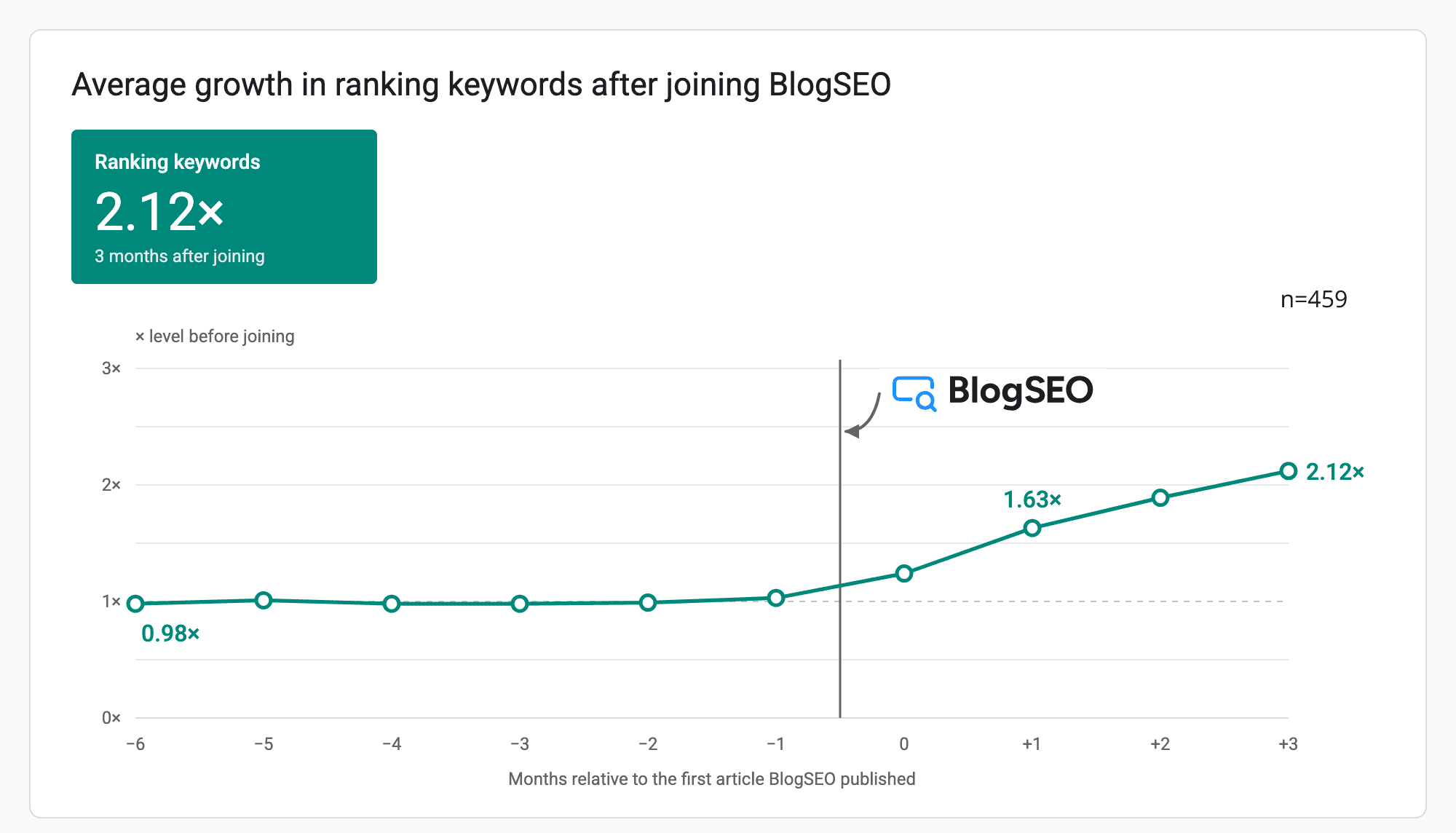
The curve has two parts. For 6 months before joining, the average hovers around 1×: on average, the sites rank for roughly the same number of keywords month after month. From the first article, it climbs every month: 1.24× in the first 30 days, 1.63× in the second month, 1.89× in the third and 2.12× in the fourth (month +3).
Values are relative to each site's own average over months −3 to −1 (1× = pre-joining level). Panel: 459 websites.
Clicks and impressions: 2.01× and 2.68× on average
Impressions count how often a site appears in Google results. Clicks count how often searchers actually visit it. Both lines below come from the same 419 websites, each with at least 30 clicks a month before joining.
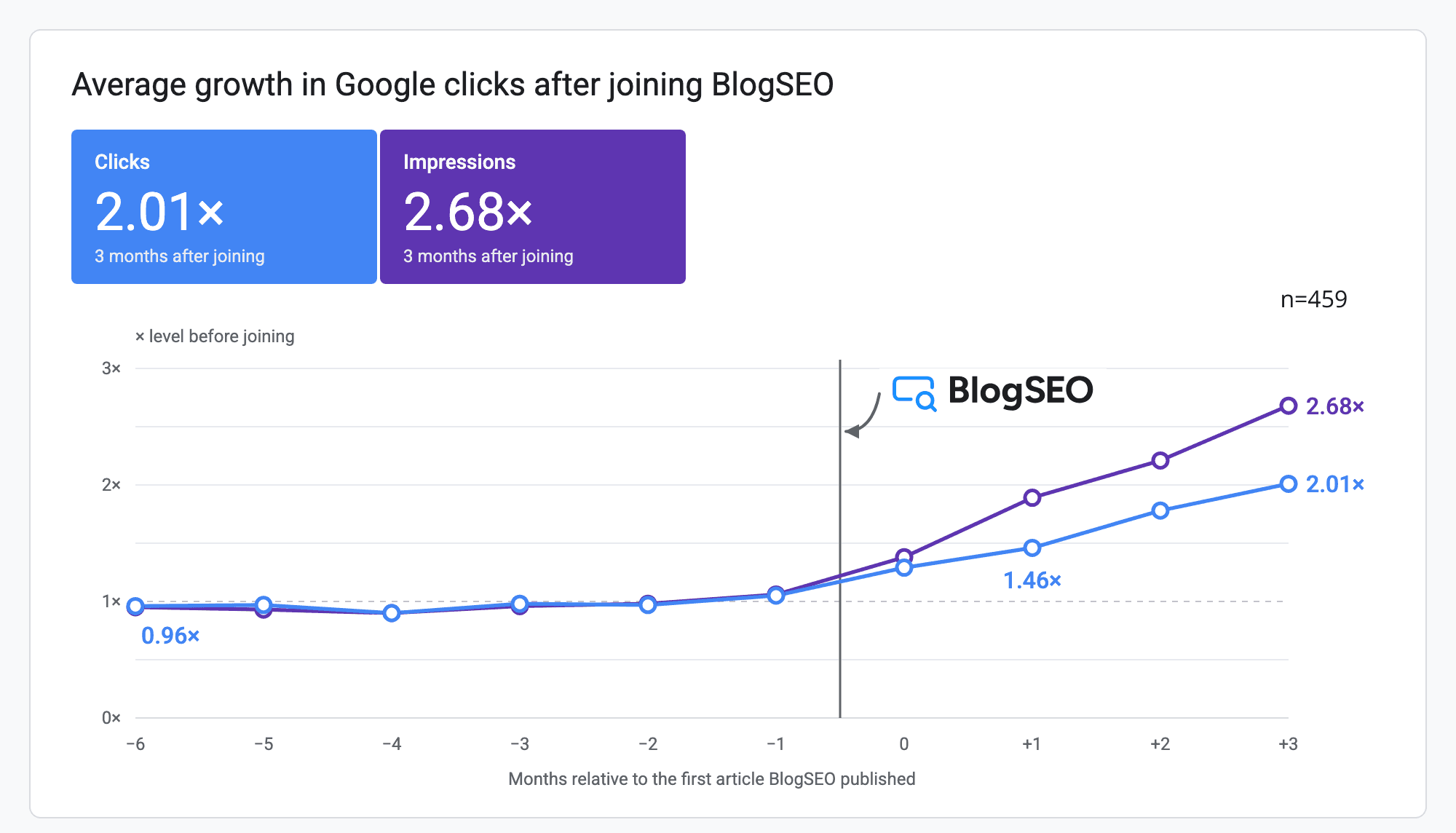
Impressions grow faster than clicks: 2.68× against 2.01× on average at month +3. That fits a familiar SEO pattern: new rankings usually start low in the results, where they collect impressions long before they collect clicks.
Values are relative to each site's own average over months −3 to −1. Panel: 419 websites.
Before joining: a flat baseline
From month −6 to month −1, all three averages stay between 0.90× and 1.06×. On average, the sites were neither shrinking nor already climbing before BlogSEO published its first article on them.
That matters for two reasons:
- It addresses the most common objection. If the sites had already been growing fast, the post-joining curve could simply be the continuation of a trend that started earlier. A flat average before joining makes that explanation less likely.
- It makes the break visible. Average ranking keywords go from 1.03× in the month before joining to 1.24× in the first 30 days, then keep rising. A change in direction that lines up with the joining date is much easier to read than a gradual drift.
Joins were spread over roughly 8 months, so "month 0" falls on different calendar dates for different sites. That reduces the chance that one Google update or one seasonal peak explains the whole curve, although it does not remove it entirely (see methodology and limitations).
A clear before-and-after pattern
Across the same fixed panels, the averages stay close to the pre-joining baseline for the six months before the first article, then rise in every measured month afterwards. At month +3, the 459-site ranking-keyword panel reaches 2.12× its baseline. The 419-site clicks and impressions panel reaches 2.01× and 2.68× respectively.
Why would rankings and impressions grow faster than clicks? This is a well-known SEO pattern rather than something this study measured directly. A new article can begin appearing in Google results before it reaches the positions that generate many visits. It therefore starts adding ranking keywords and impressions before it earns its full share of clicks.
What BlogSEO does once a site joins
In this study, joining means the day BlogSEO published its first article on the site. The study measures what happened from that point as a whole: it does not isolate the effect of any single feature. Not every feature was active on every site during the study window (the backlink exchange, for example, launched in March 2026). Here is what BlogSEO runs for a website today:
- Keyword research. BlogSEO crawls the website, maps the pages and keywords it already has, and builds a keyword list with search volume, competition, opportunity score and search intent, grouped into topic clusters that feed the content calendar. With Search Console connected, keywords the site already ranks for are deprioritized to avoid cannibalization.
- Articles in your brand's voice. Each article is researched and written with frontier reasoning models, and ships with a main image and up to two inline images, contextual internal links to your existing pages, a meta description and structured data.
- Automatic publishing on a schedule. Articles go live on the schedule you set, one a day by default, on 23+ platforms including WordPress, Shopify, Webflow, Wix, Framer and Ghost, through a custom webhook, or on a hosted blog on your own subdomain. See the full list of integrations.
- Backlinks included in paid plans. BlogSEO matches your website with member sites in the same niche and places contextual, non-reciprocal links to your pages inside their articles, verified by a crawler. Read how the backlink exchange works.
- Rank tracking from Search Console. With Google Search Console connected, BlogSEO tracks ranking keywords, clicks, impressions and positions over time, per keyword and per article, which is the same kind of data this study is built on.
If you want to see the whole workflow before signing up, the demo walks through setup, the content calendar, keyword strategy, rank tracking and the backlink exchange.
Methodology and limitations
Population and panels
- Dataset studied: 459 BlogSEO websites.
- Data source: Google Search Console (worldwide), available from May 2025 to October 2026.
- Ranking keywords panel (459 websites): websites with a full 10-month Search Console window and at least 10 ranking keywords per day before joining.
- Clicks and impressions panel (419 websites): websites with a full 10-month Search Console window and at least 30 clicks per month before joining. The same 419 sites are used for both lines.
- Why the floors: a site with a handful of ranking keywords or clicks can show a huge ratio after gaining only a few more. The minimums keep tiny sites from producing absurd ratios.
- Timing: joins were spread over roughly 8 months.
Definitions
- Joining date (start of month 0): the date of the first article BlogSEO published on the site.
- Months: consecutive 30-day blocks relative to the joining date. Month −6 to month −1 are the six blocks before joining, month 0 is the first 30 days starting with the first article, then month +1, +2 and +3. Month +3 covers days 91 to 120 after the first article.
- Ranking keywords: for each day, the number of search queries for which the site appears in Google's top 100 results, from Google Search Console (worldwide), averaged over each 30-day block.
- Clicks and impressions: daily Google Search Console totals, averaged over each 30-day block.
- Baseline (1×): each site's own average over months −3, −2 and −1. Every month of every site is divided by that site's baseline, so 2× means twice the site's pre-joining level.
- Averages: the plain mean of those per-site ratios. Each website counts once, whatever its size: a 100,000-page site does not outweigh a 50-page site.
Limitations
- No control group. We did not compare these sites with similar sites that did not join BlogSEO, so seasonality and Google algorithm updates are not modelled. Joins spread over roughly 8 months reduce that risk, but do not remove it.
- Survivorship. The panels only include sites still connected with full Search Console data through month +3. Sites that disconnected or left earlier are not in the averages.
- Only 3 months after joining. The study stops at month +3. It says nothing yet about what happens at 6 or 12 months.
- Averages summarize the panel, not every individual experience. Each website counts once, and results can vary from site to site.
- Correlation in time, not a randomized experiment. The changes line up with the joining date, but this design cannot prove cause and effect the way a randomized test would.
FAQ
How long does it take to see results after joining BlogSEO?
In this study, all three averages moved in the first 30 days after the first article: 1.24× for ranking keywords, 1.29× for clicks and 1.38× for impressions. They kept rising every month after that, to 2.12×, 2.01× and 2.68× at month +3. The study stops at month +3, so it does not tell you where the curves go after that.
Why do impressions grow faster than clicks?
Impressions count every appearance in Google results, including positions far down the list. Clicks mostly come from page one. A well-known SEO pattern is that new pages first rank low, collect impressions, and then climb toward page one over time. That is the likely reason impressions reached 2.68× on average while clicks reached 2.01×, although this study did not measure positions directly.
What does the "n" in the corner of the charts mean?
The label shows the size of the panel behind that chart: 459 websites for ranking keywords, and 419 websites for clicks and impressions. Each curve follows the same panel through all 10 months.
Can I see this data for my own website?
Yes. Connect Google Search Console in BlogSEO and the analytics dashboard shows your ranking keywords, organic clicks, search appearances, indexed pages and positions over time, with per-keyword clicks, impressions and CTR. The connection is read-only.
Is this a guarantee of results?
No. These are panel averages, and individual results can vary. The study shows what happened on average after joining BlogSEO, not what will happen on any particular site.
Check your own numbers
The fastest way to know whether this pattern holds for you is to measure it on your own site. You can check where any website ranks on Google for a keyword with our free Google rank checker, no signup needed. When you are ready to publish, start your free trial: connect your CMS and Search Console, and you can follow your own ranking keywords, clicks and impressions month by month from the first article.