WordPress Integration
Connect BlogSEO to your WordPress site to automatically publish AI-generated articles directly to your blog with full SEO optimization.
We support two connection methods:
- BlogSEO Plugin, recommended for hostile hosting environments (Hostinger, Wordfence, Really Simple Security) and the easiest setup.
- Application Password, uses WordPress's built-in Application Passwords (WordPress 5.6+).
WordPress Plugin Integration
This is the recommended way to connect BlogSEO to WordPress. Unless you have a specific constraint, like not wanting BlogSEO to appear inside your WordPress admin, you should almost always use this integration over the Application Password method.
Installing the plugin
-
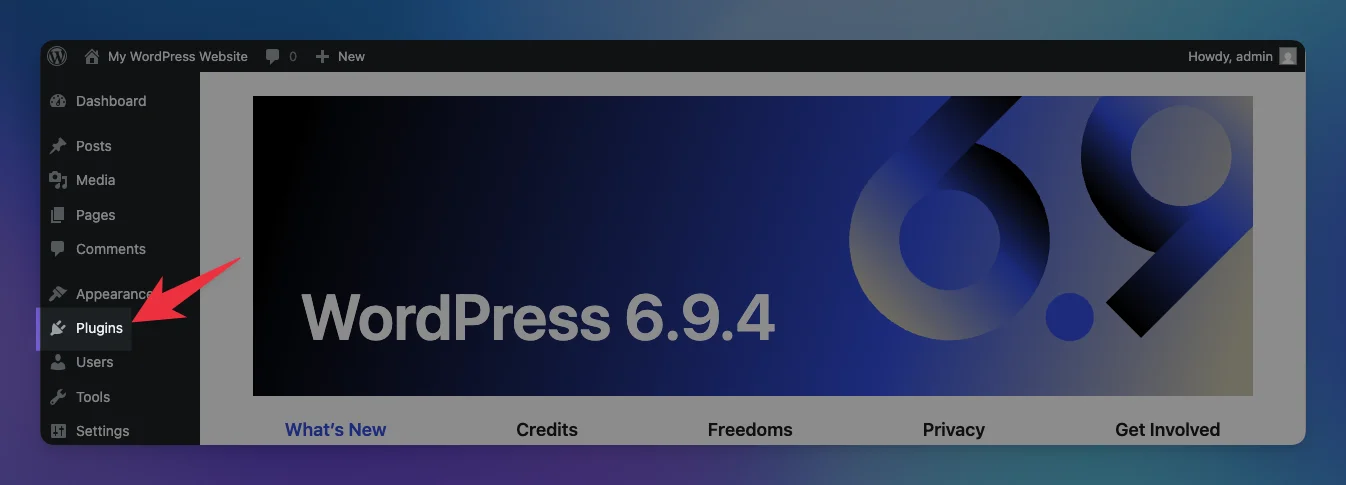
In your WordPress admin, open the Plugins menu in the left sidebar.
-
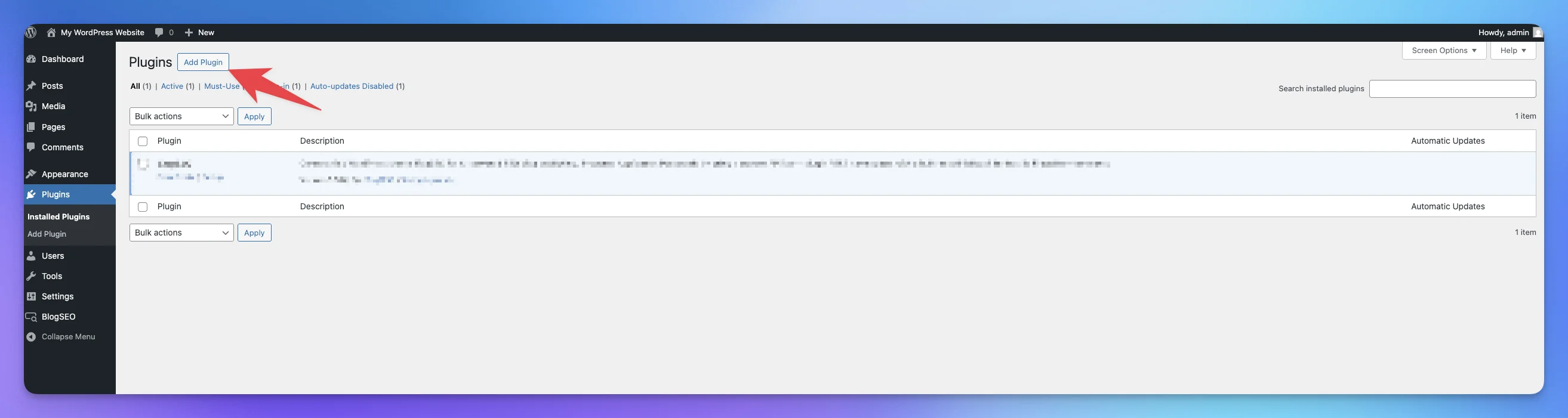
At the top of the Plugins page, click Add Plugin.
-
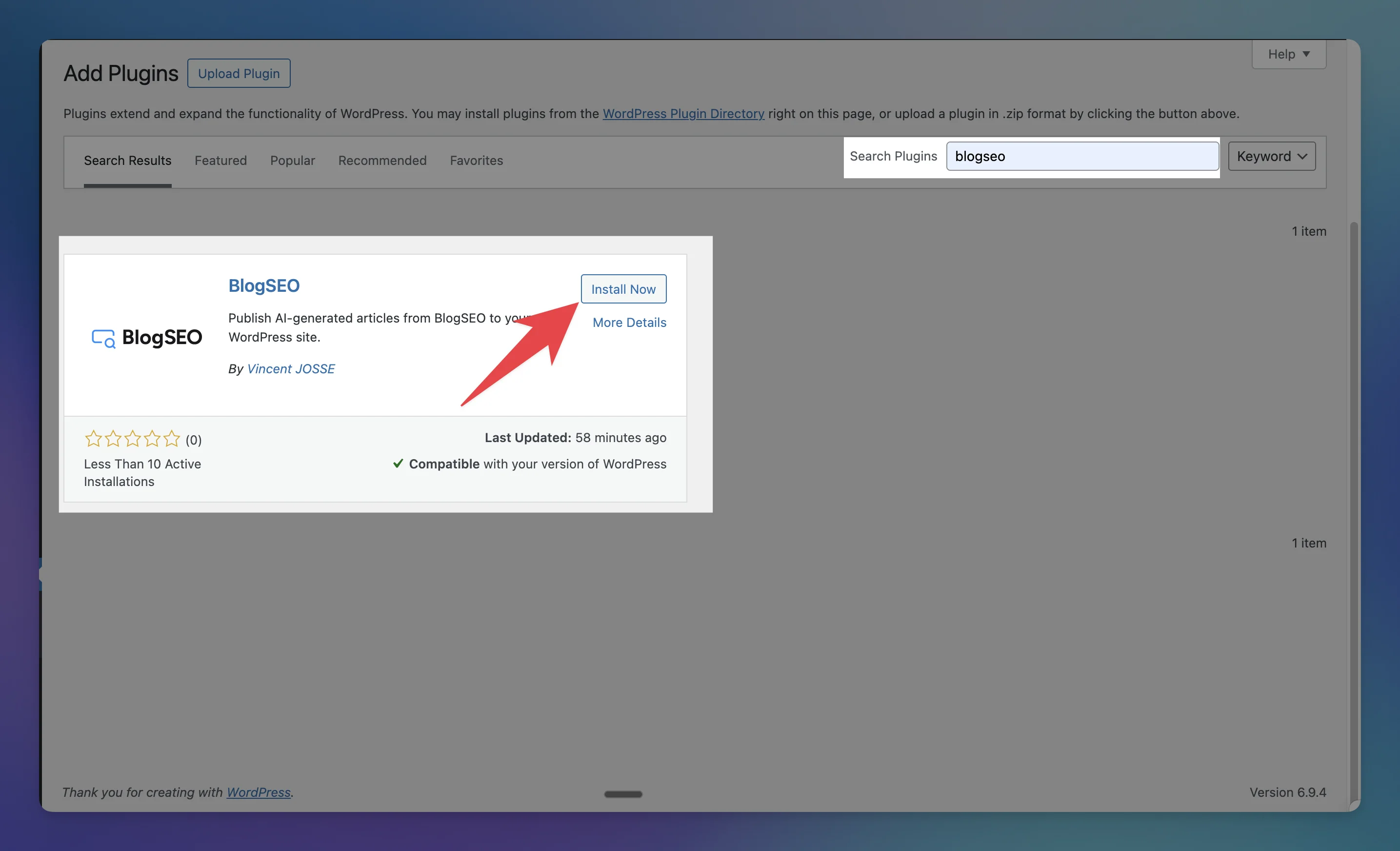
In the search bar at the top right of the page, type BlogSEO. Our plugin should appear at the top of the results.
-
Click Install Now, then Activate once the install finishes.
-
Head over to your BlogSEO dashboard at Integrations → WordPress to finish connecting your site.
-
Click Connect via plugin, then confirm your website URL on the next screen. You'll be redirected to your WordPress admin to validate the pairing between the BlogSEO plugin and your BlogSEO account.
Once you approve the connection, you're good to go!
From your BlogSEO dashboard, you can control whether articles are auto-published to WordPress. If you enable auto-publish, you can also choose whether articles go out as drafts (so you can review them before they're live) or are published immediately.
If you'd rather keep auto-publish off, you can still manually push any article to WordPress from its article preview in BlogSEO.
Automatic two-way syncing
Once connected, the plugin keeps your BlogSEO dashboard in sync with WordPress automatically. Any new categories, tags, or post types you add in WordPress show up in BlogSEO on their own, so when you generate an article you can target them right away without re-pairing or refreshing anything.
If your site uses an aggressive security plugin that blocks a lot of incoming requests, syncing may take a little longer to complete, but it will still get there reliably.
Frequently Asked Questions
Does BlogSEO fill in my Yoast / Rank Math / SEO plugin metadata automatically? Yes. Every published article automatically populates the meta title, meta description, focus keyword, canonical URL, Open Graph and Twitter card fields, and schema article type for whichever SEO plugin you have active: Yoast, Rank Math, All in One SEO, SEOPress, or Squirrly. No manual editing required.
Will the BlogSEO plugin slow down my WordPress site? No. The plugin is intentionally very lightweight. It doesn't load any code on the front-end of your site, doesn't add scripts or styles to your pages, and doesn't run on every request. Background work happens on a low-frequency schedule and only sends data when something has actually changed, so visitors and your page speed scores are unaffected.
Can I edit articles after they're published to WordPress? Yes. Edit them directly in WordPress, or update them in BlogSEO and click Sync to CMS to push the changes.
Where can I download the BlogSEO WordPress plugin? The plugin is hosted on the official WordPress plugin directory at wordpress.org/plugins/blogseo. Installing through the Plugins → Add New search inside your WordPress admin pulls it directly from there, so updates flow through the standard WordPress auto-update mechanism.
Application Password Integration
This method is not recommended. Use the WordPress Plugin above unless you have a specific reason to avoid it (for example, you can't install plugins on your site, or your host blocks them). The Application Password flow tends to break when security plugins like Wordfence are installed and is harder to troubleshoot.
The Application Password method uses WordPress's built-in REST API and authenticates with a secure Application Password generated during the connection flow.
Requirements
- WordPress 5.6 or later
- Administrator or Editor access
- Application Passwords enabled (disabled by default on Wordfence and Hostinger, see warnings below)
- The REST API must be reachable at
/wp-json/(see REST API not accessible if not) - The path
/wp-admin/authorize-application.phpmust be accessible (see Hide My WP Plugin)
If you use Wordfence, Application Passwords are disabled by default. Go to Wordfence → All Options → Login Security Options and uncheck Disable WordPress application passwords.
If you use Hostinger, Application Passwords are also disabled by default. Re-enable them in the Hostinger plugin for the integration to work.
Setting Up
Navigate to Integrations → WordPress in your BlogSEO dashboard, then click Connect via Application Password.
Enter your full WordPress site URL (e.g. https://yourblog.com). BlogSEO redirects you to WordPress to authorize the connection, then returns you to the dashboard.
Troubleshooting
If you're stuck, reach out via the in-app chat or support@blogseo.io. We usually reply within 24 hours.
REST API not accessible
BlogSEO needs to reach https://yourblog.com/wp-json/ and get a JSON response. If it returns HTML (or 404), the connection will fail.
The most common cause is Plain permalinks. With Plain permalinks, WordPress doesn't register the rewrite rules that route /wp-json/ to the REST API.
Fix:
- Open Settings → Permalinks in WP admin.
- Pick anything other than Plain (e.g. Post name).
- Click Save Changes to regenerate the rewrite rules.
To verify, run curl https://yourblog.com/wp-json/. It should return JSON describing your site, not HTML.
If /wp-json/ is still not accessible, check that:
- No security plugin (Wordfence, Really Simple Security, Patchstack) is blocking the
/wp-json/namespace. - Your host (e.g. Hostinger, WP Engine) isn't stripping the
Authorizationheader on REST requests.
If you can't get the REST API working, use the WordPress Plugin Integration instead. It bypasses /wp-json/wp/v2/ entirely.
Connection Failed
- Verify your WordPress site URL is correct and includes
https://. - Ensure your WordPress site is publicly accessible.
- Check that Application Passwords are enabled and no plugin is blocking them.
Publishing Errors
- Confirm your WordPress user has Editor or Administrator permissions.
- Check that your Application Password hasn't been revoked.
- Verify your WordPress site isn't blocking REST API requests.
Hide My WP Plugin
The Hide My WP plugin blocks /wp-admin/ access, including /wp-admin/authorize-application.php which is required for the Application Password flow.
Option 1: Temporarily disable the plugin
- Disable Hide My WP for the connection process.
- Connect WordPress in BlogSEO.
- Re-enable the plugin once connected.
Option 2: Whitelist the authorization endpoint
In Hide My WP settings, add an exception for:
/wp-admin/authorize-application.php
Once connected, BlogSEO only uses /wp-json/ (which Hide My WP usually doesn't block), so publishing works after the initial setup.
Frequently Asked Questions
Does BlogSEO fill in my Yoast / Rank Math / SEO plugin metadata automatically? No. The WordPress REST API blocks third-party SEO plugin meta keys (Yoast, Rank Math, All in One SEO, SEOPress, Squirrly) unless they have been explicitly registered as REST-accessible, which most of them are not. If you rely on these fields, switch to the WordPress Plugin integration, which writes metadata directly inside WordPress and bypasses this limitation entirely.
How do I switch from the Application Password integration to the BlogSEO plugin? Head over to your Integrations → WordPress dashboard and delete your existing Application Password connection. Then redo the steps in the Installing the plugin section above, and everything will work just fine.
I cannot connect my WordPress website to BlogSEO, can I get help from the support team? Yes. If you're stuck after troubleshooting, our team can adjust your site's configuration for you. You may need to provide credentials, or we can guide you through the steps over a video call. Reach out via the in-app chat or support@blogseo.io.